
NewLedger MCP Is Now Available for AI Agents and Accounting Workflows
Connect AI agents and systems to governed accounting workflows with consent, scoped MCP tools, draft actions, and visible activity.
Evaluating this for a platform, firm, or fintech product? Explore our embedded accounting infrastructure overview

NewLedger MCP is now available.
With this release, teams can connect AI systems to accounting workflows in a way that is explicit, scoped, and reviewable.
That means an operator can authorize access, expose a known set of tools, let an agent retrieve finance context or create draft records, and still keep activity visible inside a governed workflow.
For accounting infrastructure, that matters more than generic AI chat. The real value comes when finance operations stay structured enough for people and agents to work from the same system without losing control.
This post reflects the NewLedger MCP capabilities available on April 30, 2026 and is reviewed by the NewLedger Product Team.
A Practical Example
Here is the kind of workflow NewLedger MCP supports today:
- an operator connects an MCP-compatible client to NewLedger
- consent is granted with an explicit scope
- the client discovers available accounting tools
- the agent retrieves context or creates a draft invoice or expense
- the resulting activity stays visible for review
That is the difference between an AI demo and a workflow teams can actually put near finance operations.
What Users Can Do Today
With this release, teams can use NewLedger MCP to:
- complete a governed consent and connection flow
- discover available accounting tools through MCP
- review recent journal entries
- create draft invoices from structured prompts
- create draft expenses from structured prompts
- review agent-visible activity tied to MCP-driven operations
Today, that is best understood as a controlled starting point for AI-assisted accounting work, not a blanket automation layer.
The practical caution is important:
- access should stay scoped to the tools a team actually wants to expose
- draft actions are safer than fully automated posting
- review and operator visibility should remain part of the workflow
That gives product, engineering, and finance teams a real starting point for AI-assisted accounting work instead of a purely conceptual roadmap.
Available Now
Today, the strongest practical use cases are:
- connecting an MCP-compatible client through an explicit OAuth consent flow
- discovering which accounting tools are available to that connection
- retrieving accounting context such as recent journals
- creating draft invoices for sales-related workflows
- creating draft expenses for operational finance workflows
- reviewing visible activity produced by MCP-driven actions
What this release does not claim is equally important:
- it is not unrestricted accounting automation
- it is not hidden background access to finance data
- it is not fully autonomous posting without review boundaries
That distinction matters for trust. In accounting, useful automation only becomes credible when teams can see the scope, understand the action boundary, and keep review in the loop.
Example MCP Capabilities Available Now
To make this more concrete, the current MCP release already supports a practical accounting surface that teams can evaluate directly:
- consent-based connection setup through OAuth
- tool discovery for the accounting tools exposed to that connection
- recent journal visibility for accounting context
- draft invoice creation for sales-related workflows
- draft expense creation for operational finance workflows
- activity visibility for reviewable MCP-driven actions
That combination matters because it goes beyond a generic agent integration. It gives teams a governed accounting system they can inspect, query, and use for reviewable draft work from day one.
Where MCP Fits In The Product Story
We think about MCP as an interface layer for structured interaction, not as a protocol announcement for its own sake.
In practical terms, that means a system where AI can:
- retrieve finance context more cleanly
- understand workflow state
- assist with actions inside governed boundaries
- help operators work faster without bypassing controls
For accounting infrastructure, that matters far more than generic AI chat alone.
Why Scope, Permissions, and Risk Matter
Finance workflows are sensitive by default.
That is why NewLedger MCP is designed around governed access rather than broad, hidden connectivity.
In practice, teams should think about:
- which tools an agent can access
- what accounting context it can retrieve
- which actions remain draft-only or reviewable
- where human approval is still required
- how activity stays visible to operators
The risk in AI-assisted accounting is rarely just bad output. It is unclear scope, over-broad permissions, and workflow actions that happen without enough review context.
For teams evaluating MCP, scope and permissions are part of the product design, not secondary implementation details.
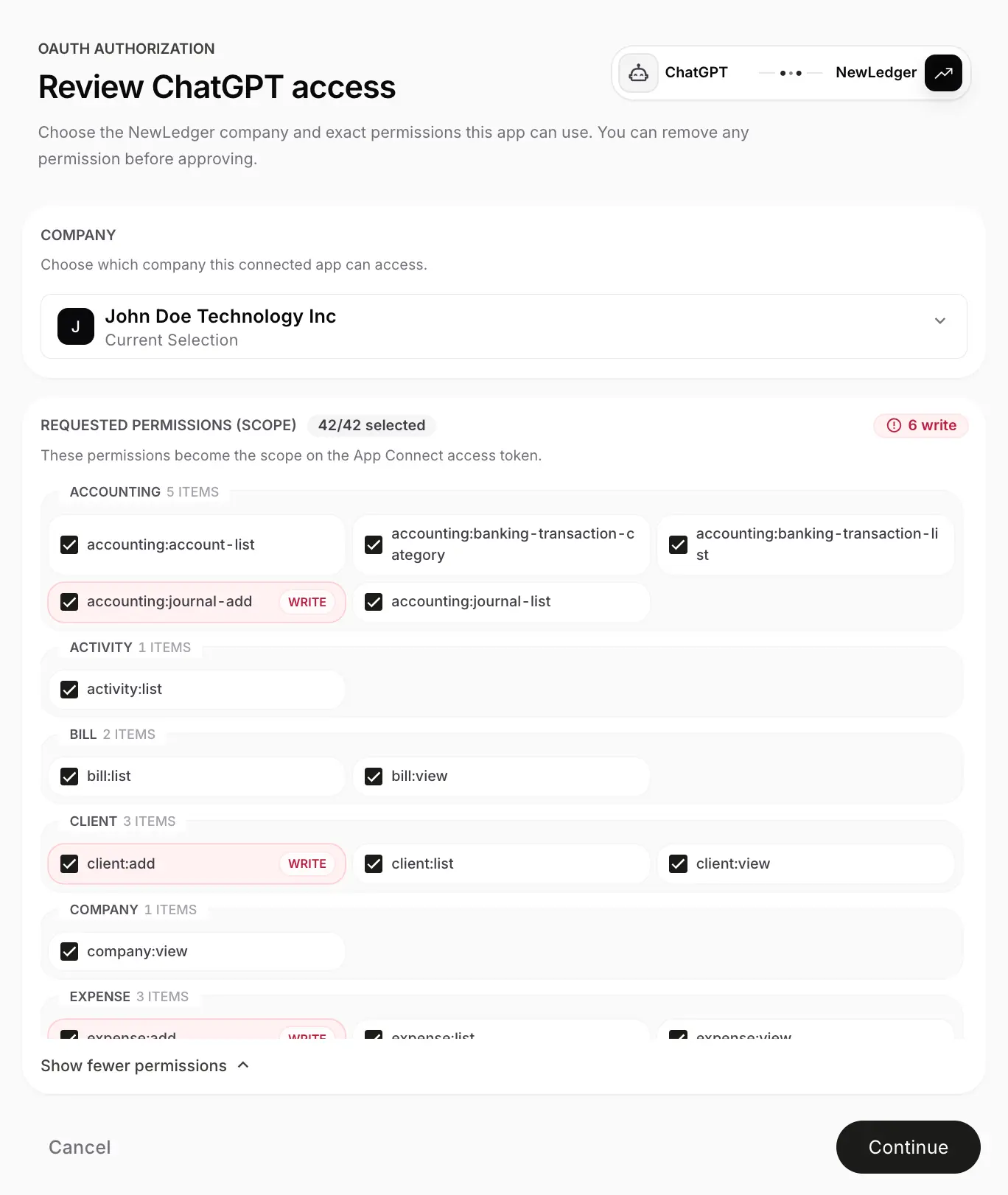
Consent and authorization are part of the workflow boundary. AI access should be explicit, reviewable, and tied to a known scope.
In practice, this means a team can decide whether an MCP client should only retrieve context, or whether it should also be allowed to create draft records. That kind of scope boundary is part of the accounting workflow itself, not just an implementation detail.
Why Sales, Purchases, and Expenses Are Good Starting Points
These workflows are especially valuable because they are both operational and accounting-relevant.
Sales
Sales workflows often drive invoices, receivables, approvals, and reporting implications. AI support is useful here only when the accounting layer is clear enough to reflect what happened.
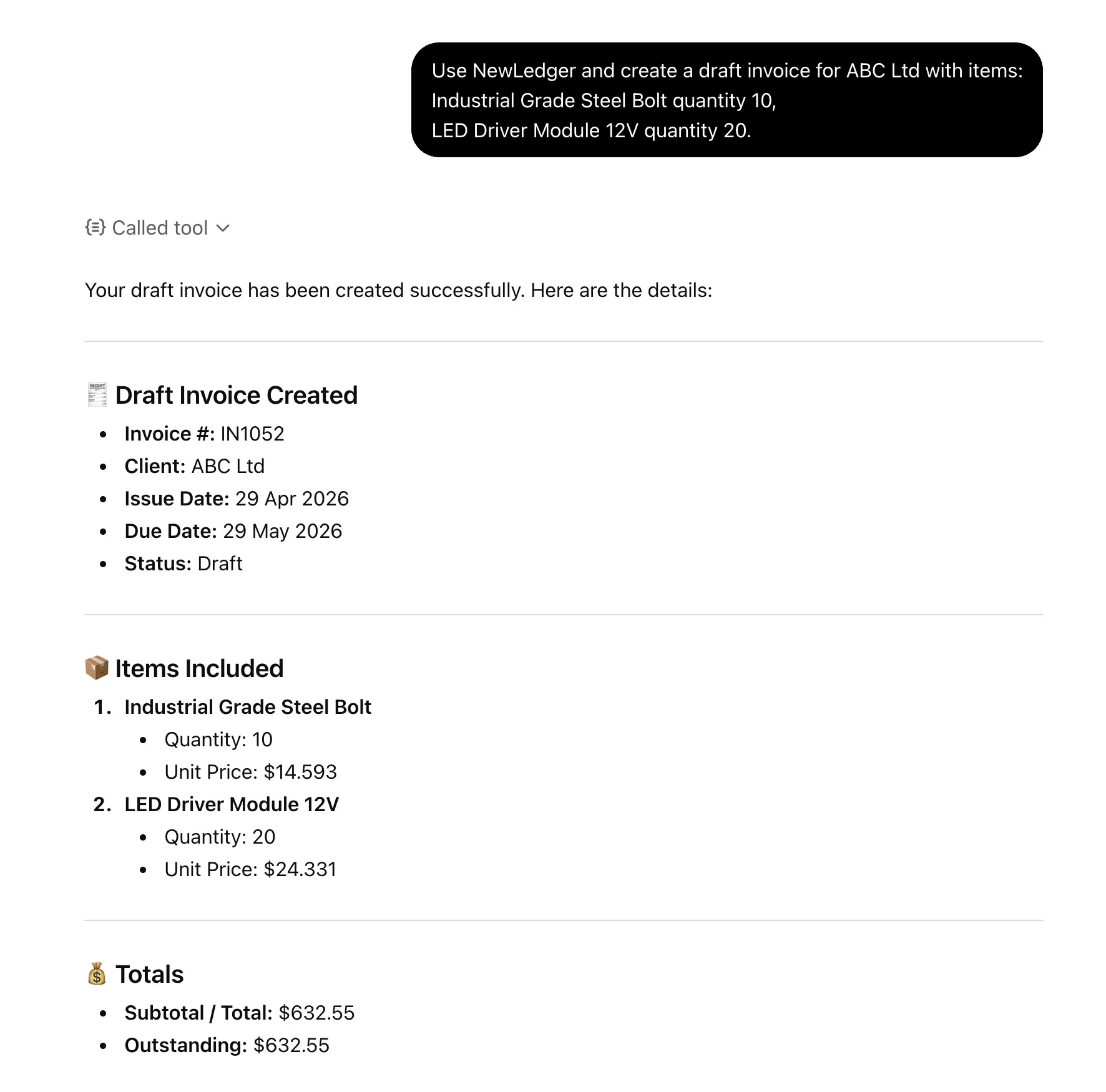
Draft invoice creation is a strong example of AI assisting with structured sales workflows inside governed accounting rails.
Purchases
Purchase workflows involve approvals, coding, review, and accounting treatment. They are strong candidates for structured automation and agent-assisted execution because they already depend on clear workflow state and review boundaries.
Expenses
Expense operations already benefit from AI in areas like categorization and documentation, but the real value comes when that intelligence connects to governed finance workflows and dependable posting logic.
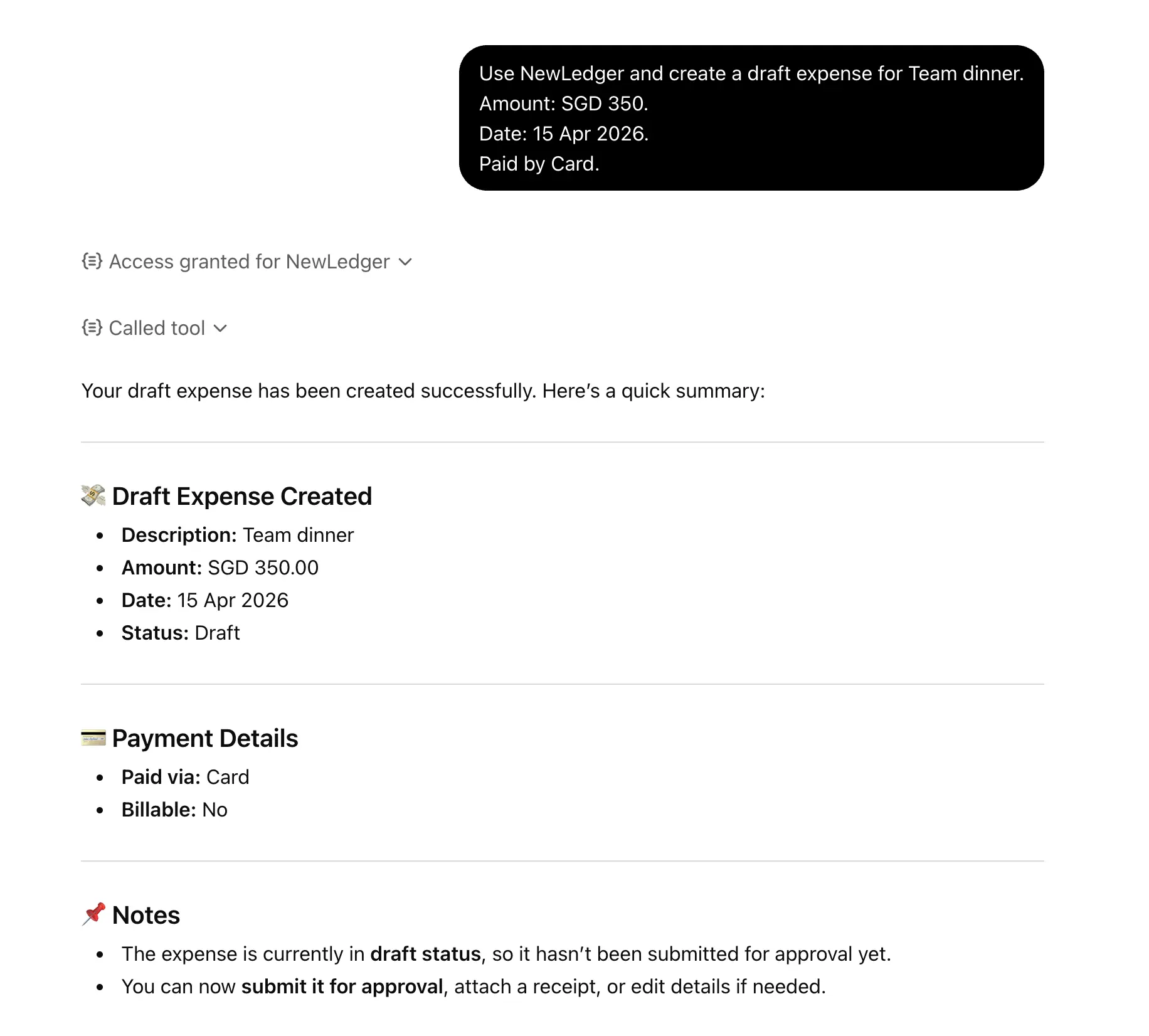
Expense creation is one of the clearest examples of AI assisting with operational finance work without stepping outside structured workflow boundaries.
What A Team Can Actually Try
For a product, engineering, or finance team evaluating NewLedger MCP today, a realistic first trial looks like this:
- connect an MCP-compatible client to NewLedger
- approve a known scope through consent
- inspect the tools exposed to that connection
- ask for recent accounting context such as journal visibility
- create a draft invoice or draft expense from a structured prompt
- review the resulting activity trail before deciding what to operationalize next
That is a practical adoption path because it starts with observable, reviewable workflows rather than high-risk automation claims.
A Safer Starting Model For AI In Accounting
The practical model is not unrestricted automation.
It is:
- explicit consent
- scoped tool access
- reviewable draft actions
- visible activity history
- accounting workflows that stay inside known controls
That is the operating model NewLedger MCP is built to support as teams explore AI-ready accounting operations.
What This Means For Customers
For customers evaluating NewLedger, this matters because it points to embedded accounting infrastructure that can support both today’s operational finance work and tomorrow’s deeper agent-assisted workflows.
NewLedger already sits close to the operational finance layer:
- sales workflows
- purchases
- expenses
- bookkeeping foundations
- reporting
- finance controls
That creates the right conditions for AI systems to work with accounting processes in a way that stays structured and dependable.
It is especially relevant for:
- fintech teams
- vertical SaaS products
- embedded accounting use cases
- businesses that want finance operations inside the product experience
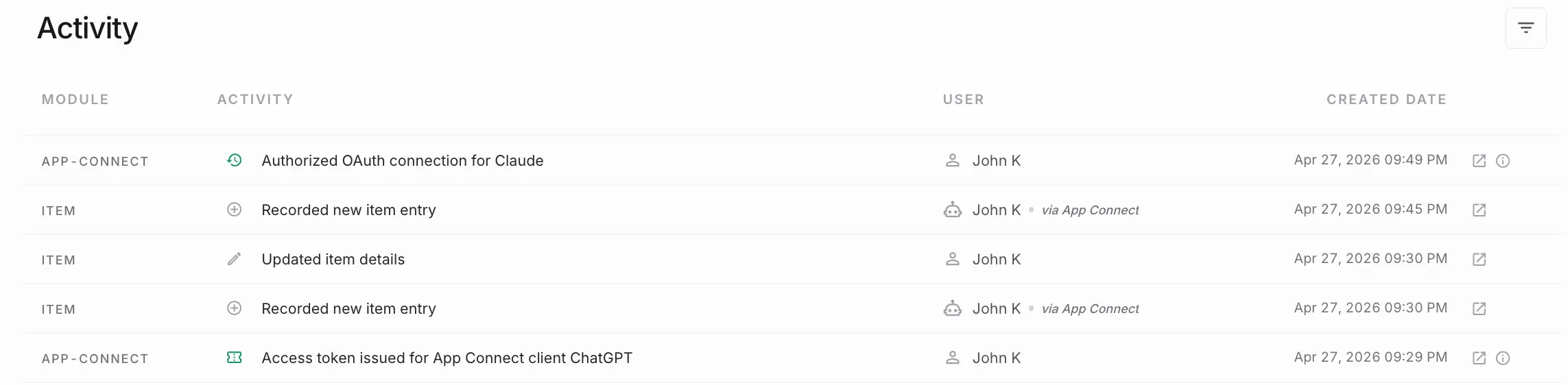
Agent activity visibility helps turn AI readiness into something operational teams can actually trust.
What Comes Next
We expect the next phase of accounting infrastructure to be shaped by better interfaces, better workflow structure, and better readiness for AI-assisted operations.
That is where NewLedger MCP fits.
It is not about replacing accounting judgment. It is about making accounting systems more usable by the operators, products, and agents that increasingly depend on them.
Closing Thought
The future of AI in finance will belong to products that combine automation with trust.
NewLedger is building for that future by making accounting workflows structured enough for humans, operators, and AI agents to work from the same dependable accounting foundation.
Read Next In This Series
- For the infrastructure foundation, read AI-Ready Embedded Accounting.
- For the embedded-accounting interface view, read MCP for Embedded Accounting Infrastructure.
- For the platform-design guide, read How to Build an Agent-Ready Accounting Platform.